Blazing a New Trail

Dolores Petropulos
After retiring from the Orlando police force, Dolores Petropulos aimed for a new career in computer science. An internship with NASA's Undergraduate Student Research Project, or USRP, helped her advance her passion for computer programming and spark a new dream of working in robotics and artificial intelligence.

In which NASA student opportunity project did you participate, and how did you get involved in it?

I was offered a USRP internship by NASA's Johnson Space Center in Houston, Texas. I applied on SOLAR (Student Online Application for Recruiting Interns, Fellows and Scholars).

Explain the research you conducted through your NASA involvement and why this topic is important.

I developed, tested and used simulation software for Project Morpheus, the second prototype (version 1.5) of an autonomous rocket/moon lander. In classical mythology, Morpheus is a god of dreams. He appeared in the dreams of mortals and had the ability to take any male human form. In the NASA Johnson Space Center research project Morpheus, the next moon lander/rocket is designed for autonomous flight or many different types of flight. It is portable and could be used to send a robotic or manned mission to a distant planet. Morpheus has an onboard navigation and guidance system and a precision landing and hazard avoidance system (ALHAT). These systems will allow Morpheus to fly autonomously, or with limited interaction from mission control. The ALHAT project stands for Autonomous Landing and Hazard Avoidance Technology and involves active sensors for terrain-relative navigation and hazard avoidance. Morpheus' propulsion system consists of an oxygen/methane fuel-type system, which also can be derived from space and terrestrial atmospheres, providing potential in situ resource use opportunities. My work on this project involved developing, testing and using simulation and flight software. In particular, I have been incorporating portions of the capabilities of the Autonomous Flight Manager into the NASA Goddard Core Flight Software, which was obtained at the beginning of the Morpheus project. Reuse of the proven Core Flight Software with new software components specific to Morpheus is an experiment in affordable extensibility of a vehicle's capability. The software components specifically involved in my project are the Autonomous Flight Manager, the Sequencer and the Limit Checker.


Mindi Capp/NASA Educational Technology Services
Continue Reading...

Engineers in Training

Sometimes I think that taking the exploration work we do to the public is as important for us as it is for them.

Explorer
We'd cordoned off three sides of Morpheus at Space Center today to prevent unauthorized pinching, patting, or souvenir sampling of the lander. However, Tom Campbell, the Morpheus GNC hardware engineer, had the great idea to take kids that showed interest onesy-twosey down on the ground to look under the lander and see the rocket motor. The effect was striking. You could see the light in the kids' eyes after they got up from the baking concrete. They'd just seen a rocket engine that changes the temperature of its propellant almost 3000 degrees F in less than a foot and a half of travel.

Tom's words after one kid got up and walked away chatting to his parents:

"We just made another engineer."

Look Out for Those Rocks!


The words "hazard field" certainly never were associated with the Shuttle Landing Facility at NASA's Kennedy Space Center in Florida. To the contrary, the goal was to keep the runway area free of any hazards that might endanger the shuttle and crew during landing. But that is about to change when, in the not-too-distant future, the facility will offer a prototype space vehicle the kind of landing hazard field necessary for realistic testing.

An area near the runway will be turned into a field of hazards as part of the next phase of tests for the Project Morpheus lander, which integrates technologies that someday could be used to build future spacecraft destined for asteroids, Mars or the moon. The lander has been undergoing testing at NASA's Johnson Space Center in Houston for almost a year in preparation for its first free flight. During that flight testing, it will rise almost 100 feet into the air, fly 100 feet laterally, and then land safely.


Testing Picks Back Up


After sticking to the ground for upgrades the past several months, the Project Morpheus prototype lander took to the skies at Johnson Space Center again on Tuesday.

Since its last round of tests in 2011, the Morpheus team has given the liquid oxygen/liquid methane-fueled lander a new engine, new avionics and a power unit redesign. In addition, the vehicle software has been substantially updated in preparation for the integration of its Autonomous Landing and Hazard Avoidance Technology (ALHAT) payload. The lander has the same oxygen and methane tanks, and the same structure, but otherwise it’s practically an all-new vehicle.

“The first series of tests gave us a basic understanding of our ability to control the vehicle and allowed us to initially characterize the performance of the subsystems on the vehicle,” Morpheus Project Manager Jon Olansen said. “With that information we were able to go back and design in upgrades to improve performance and reliability.”

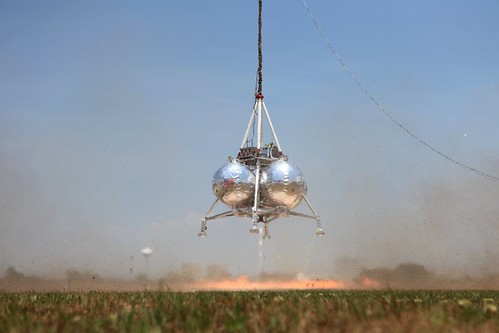
Once the upgrades were complete, it was time to start up a new series of tests. Like last time, they started with hot fire tests to demonstrate engine operation, and this week worked up to tethered testing. On Tuesday, the refitted lander successfully hovered 15 feet above the ground for 40 seconds, firing the engine for a total of 50 seconds with ignition, ascent and descent.

Delays: As Important as Testing?

In a previous blog post we discussed the importance of testing, but sometimes delays are just as important. Right now for Morpheus the best decision has been to slow down and analyze our systems before testing again. As we progress through our schedule we have certain milestones we have to reach. In our current phase, we will test as necessary to learn about our vehicle and subsystem performance. This will help us evolve the vehicle design and meet the milestones leading to conducting high-energy flights next year.

A Morpheus tether test, just after ignition credit: NASA/Joe Bibby
Don't think that the team has been sitting idle waiting for a few teams to problem solve. For example, the GN&C and software teams has been taking advantage of this time to pour over the large amount of test data we have already collected. They have used this data to improve the control layers and Morpheus simulation. These updates will be tested soon (possibly as early as August 31) in another tethered test (#6) of Morpheus.

These two groups along with all the other subsystems have also been busy looking into upgrades for the next version of Morpheus, referred to as Morpheus v1.5. Besides upgrades to existing systems, this also includes the beginning of integration with the ALHAT (Autonomous Landing and Hazard Avoidance Technology) Project, an important step in our development as a lander prototype.

Below is a video summarizing our current progress using tethered tests, which have been invaluable. This team has been able to design, build, and then run 4 hot fire and 5 tethered tests all in less than a year. It shows the advantages of following lean engineering and management practices and these recent delays should not cast any doubt on that. If anything they prove that lean practices still follow the appropriate levels of safety and configuration control allowing us to determine solutions to problems as they happen.


Morpheus Improvements and Incident Comments

Morpheus is still early in its test phase.  The side by side video comparison below demonstrates the progression of improvements that Morpheus has made in its first four tethered tests.  From our first test where we experienced a controller problem that drove our thruster valve full open to our fine tuning of our data system to filter out the occasional inaccurate measurements that occur, the test sequence shows the improvements that are made from test to test.  Morpheus' design approach is to test often, learn and test again.  Between each test the team gathers and processes data captured in the various systems on Morpheus.  Test dates are set as important deadlines giving team members a bit more of a sense of urgency.  This helps drive the team to make quick but informed decisions for each subsystem.    However, there is a rigorous review before each test to make sure the team is ready for test.  The tether system offers an extra degree of protection for obtaining critical test data while still protecting the vehicle.

Test. Iterate. Test again.


Download HD MOV : Download WMV

In regards to the grass fire after the last test, we work very closely with JSC Operational Safety and JSC Fire Protection Services before, during, and after each test.  JSC Fire Protection Services has staff at the test site ready to respond in case of any incident.  They also have existing protocols to bring in the Houston Fire Department for additional help.  Unfortunately immediately after the test and before the grass fire was contained, another fire call in an on-sight JSC building occurred and half the FPS personnel were required to respond to that incident.  While no one was injured and no damage was done to NASA or other property (outside of the grass of course) we do not want another grass fire of that extent.  JSC has initiated an incident review team to evaluate the grass fire response and develop mitigation strategies to allow testing to resume as soon as possible.

Fifth Tethered Hover Flight

In this fifth hover test of the vertical test bed Morpheus. Morpheus ran for the full 30 seconds of hover time. This was a very successful test with a near perfect hover.


Download HD MOV : Download WMV